The Place of Michael Oakeshott in Contemporary Western and Non-Western Thought by Noel O'Sullivan
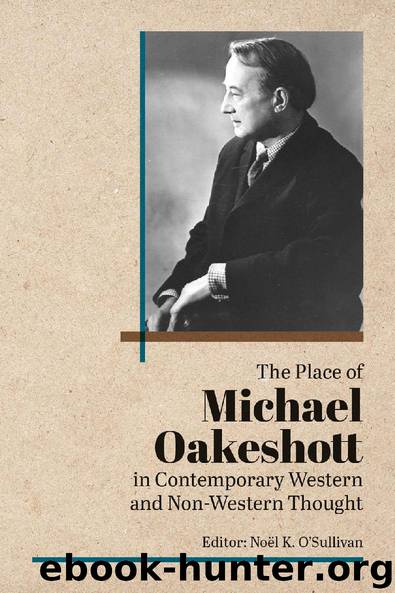
Author:Noel O'Sullivan
Language: eng
Format: epub
Tags: Philosophy, Oakeshott, idealism, politics, political theory, legend, history, practical past, morality, historicism, conservatism, modernity, Leo Strauss, Hayek, liberalism
ISBN: 9781845409494
Publisher: Andrews UK Limited 2017
Published: 2017-08-01T00:00:00+00:00
7: David Boucher
The Depoliticization of Politics
Crisis and Critique in Oakeshott, Schmitt and Koselleck
Introduction
This chapter compares the ideas of Michael Oakeshott with those of Carl Schmitt and his disciple Reinhart Koselleck on the neutralization and depoliticization of contemporary politics. By which they referred to the deliberate subversion of the political by the social, cultural and moral, curtailing the ability of the sovereign to act decisively (Schmitt, 2007, pp. 80–96; Koselleck, 1988). For Oakeshott, depoliticization takes the form of conceiving the state, not as a civil association to be governed, but as an enterprise to be managed (Oakeshott, 1975a, pp. 203–6 and 214–16). For all three the degenerative process had its roots in the Enlightenment, accelerated by the proliferation of utopian, or rationalist, ideologies, rendering rule, or governance, ineffective and corrupted. The common assumption they make is that the constitution of a government, such as monarchy, aristocracy or liberal democracy, or the binary division between despotism and republicanism, had to be distinguished from the offices of governing and the mode of association, that is, the bond by which citizens or subjects believed themselves to be associated.
At the level of mere resemblance there are certainly identities between Schmitt, Koselleck and Oakeshott, which have led interpreters, such as Duncan Bell, to claim very close affinities between them (2015, pp. 185–213). It is in terms of the mode of association, however, that we may fundamentally deny a common identity between Schmitt and Koselleck, on the one hand, and Oakeshott on the other. For both Schmitt and Koselleck it is the obedience/protection nexus that provides the bond of association. Authority is dependent upon and inextricable from power. Obligation is dependent on power. The power of the sovereign is imperative, and threats to this power constitute for them the crisis of civilization. Power and the political is eroded by the substitution of the rule of law for the rule of man. For Oakeshott power and authority are categorially distinct and obligation rests not on the expectation of protection, but upon the common acknowledgement of the authority of a system of law, that is, the idea of the rule of law, which does not specify substantive conduct, nor require approval of the substantive conditions it prescribes, but instead specifies the relationship which constitutes the bond between citizens.
Ideal-Types and History
Each takes a present condition to be indicative of a corruption of consciousness, the culmination of misunderstandings, misinterpretations, misappropriations and almost negligent optimism, the result of an irrational, or ‘rationalist’, obsession with progress, which has its origins in the seventeenth century.
Schmitt, Koselleck and Oakeshott may not, however, be accused of writing what Herbert Butterfield pejoratively termed ‘whig’ history, even though what they offer are abridgements, that is, selective readings in which all roads lead to the present. In a review of Butterfield’s The Origin of Modern Science, Oakeshott criticizes those writers who have ‘too often read the story backwards, finding significant in the past only that which led subsequently to positive achievement’ (2007, p. 298, and Buttterfield, 1949 and 1965).
All
Download
This site does not store any files on its server. We only index and link to content provided by other sites. Please contact the content providers to delete copyright contents if any and email us, we'll remove relevant links or contents immediately.
| Anthropology | Archaeology |
| Philosophy | Politics & Government |
| Social Sciences | Sociology |
| Women's Studies |
The remains of the day by Kazuo Ishiguro(8954)
Tools of Titans by Timothy Ferriss(8350)
Giovanni's Room by James Baldwin(7303)
The Black Swan by Nassim Nicholas Taleb(7091)
Inner Engineering: A Yogi's Guide to Joy by Sadhguru(6778)
The Way of Zen by Alan W. Watts(6580)
Asking the Right Questions: A Guide to Critical Thinking by M. Neil Browne & Stuart M. Keeley(5742)
The Power of Now: A Guide to Spiritual Enlightenment by Eckhart Tolle(5732)
The Six Wives Of Henry VIII (WOMEN IN HISTORY) by Fraser Antonia(5490)
Astrophysics for People in a Hurry by Neil DeGrasse Tyson(5171)
Housekeeping by Marilynne Robinson(4424)
12 Rules for Life by Jordan B. Peterson(4293)
Double Down (Diary of a Wimpy Kid Book 11) by Jeff Kinney(4253)
The Ethical Slut by Janet W. Hardy(4234)
Skin in the Game by Nassim Nicholas Taleb(4225)
Ikigai by Héctor García & Francesc Miralles(4221)
The Art of Happiness by The Dalai Lama(4117)
Skin in the Game: Hidden Asymmetries in Daily Life by Nassim Nicholas Taleb(3980)
Walking by Henry David Thoreau(3941)
